
They say the layout for the old city of Cusco (whose original name was apparently pronounced as kos-ko, which may explain why, when asking for the location of the American embassy in Cusco, natives will direct you to McDonald’s—and by the way, they have chifas too, here at 11,500 feet) is in the shape of a Puma. If you go to your favorite internet “research” sites (read, “easy answer—who cares if sources have any validation” sites), you probably won’t find mention of this; but if you dig a little deeper—i.e. click on something other than the top-ranked wikipedia link in your google search results)—, on other sites (let’s call these “conspiracy theory/whacky academician” sites), you’ll see an aerial view of the city with the superimposed outline of a pre-school-looking figure of an unrecognizable (or possible generic) quadruped. You’d have to reach pretty darn far to draw a puma conclusion on what you see, but then again the Incas probably didn’t have the appropriate aircraft for a fly-over to check the work of their urban planners.
One very cool thing that you’ll see for buildings within the mystery quadruped boundary (and, honestly, probably outside of it, since I am a little skeptical of the claim), is that the lower part of the exterior walls are Inca-laid rock, granite I believe (though all rock pretty much looks the same to me). This is pretty cool, since it means that the foundation of the buildings was retained (though build up with mismatching colonial-looking structures) due to fortitude, aesthetics, and/or engineering—or possibly belief in the puma-like (or whatever) layout. We saw many examples of such hybrid construction close to the cathedral at the center of the old city (and hence, the Monestario hotel, see previous post). Though I have no way of validating the age or the builders of the lower-part of the walls, I can easily accept that they are Inca-age, since the distance between buildings, and thus defining the streets, was barely wide enough to fit our of our little transport mini-buses (which of course leaves a full 3 inches in each side for pedestrians). The right turn to exit the square where our hotel was located was so tight that most drivers required a 5-point turn just to make 90 degrees (though I experienced as many as 7 points, and one studly driver who made it in 3 without even bashing a rim on the curb).
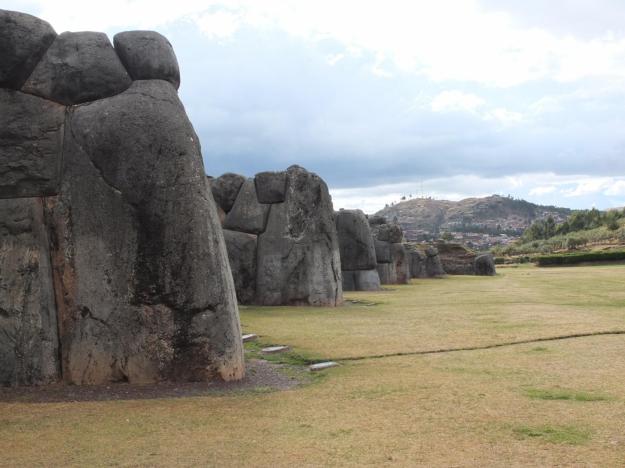
This is all a long-winded lead-in to our visit to Sacsayhuamán (which is pronounced surprising close to “sexy woman”). This means, in Quechua (and presumably, the Inca language) “head of the Puma”. It is outside of town up in the hills to the north, and the main structure (which is built of Incan-style walls and terraces) represents the head in the aerial quadruped outline. Here is a picture of the jagged teeth of the Puma (or whatever):
And here’s Mom standing next to one of the large stones representing the caps of the teeth (the Inca were darn good dentists apparently):
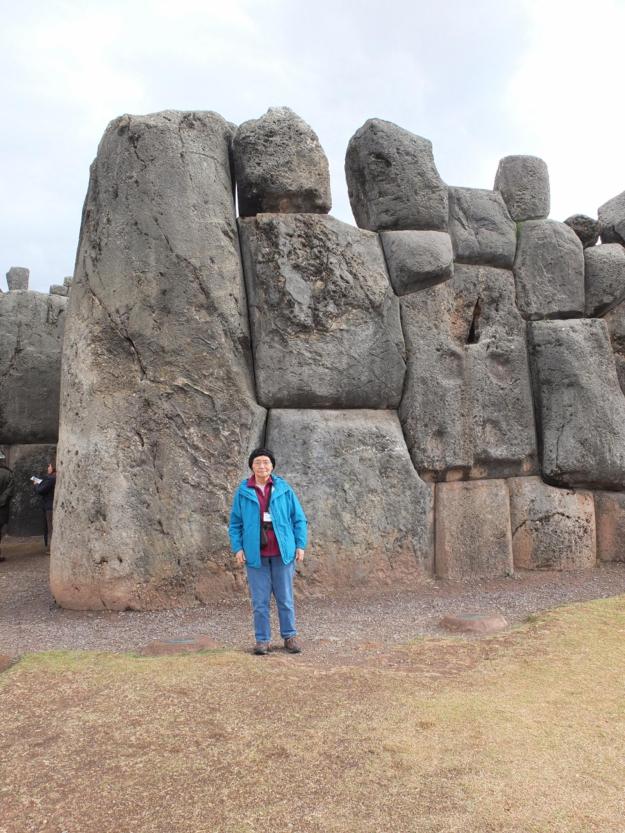
Notice how tight-fitting and awesome the construction in the lower layers is (Incas), and how apathetic and sloppy it is at the top (20th century restoration archaeologists close to—or after, or possibly during—pisco sour happy hour). Here’s a wider shot of the chin section (if you believe in that sort of thing), showing the tiered construction of the head:
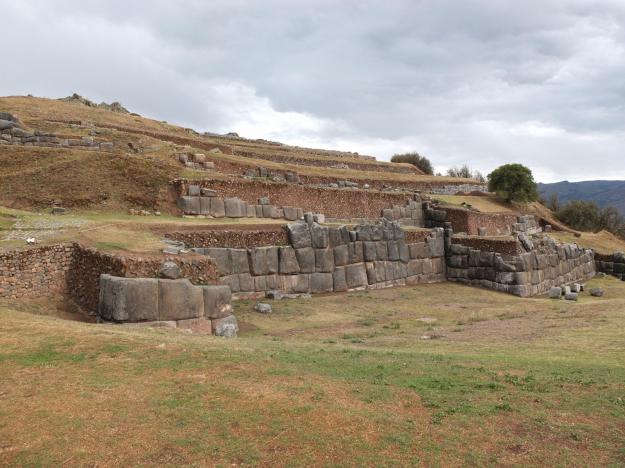
And across from the mouth/teeth is another structure of temples, currently under excavation (they didn’t really give us any information about it, so I don’t know what puma-related thing this represents), which looks like this:

The site was pretty spread out, and overall not very much excavated/reconstructed, but interesting and spiritual in its own way, and unfortunately we didn’t get much of a chance to explore. I climbed the main structure a little (to about the upper lip) to get a better view of the overall site, but didn’t see too much more. But driving back down to Cusco from here, this was the view of the city:
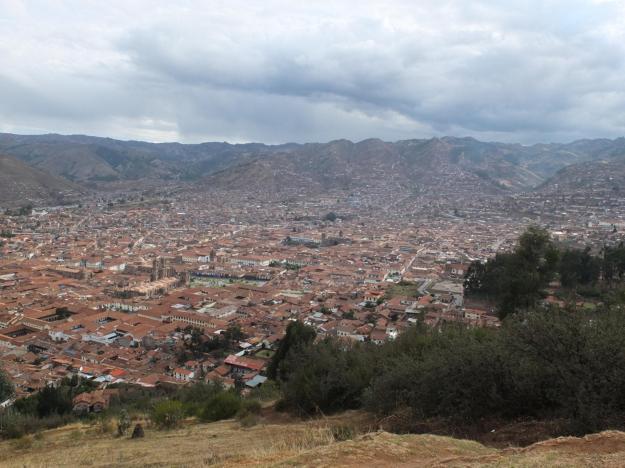
The carpet of red-tile roofs was pretty vast (whoever owns the teja factory, or better yet the controlled the distribution, must have made a killing), though I didn’t see no nothing remotely resembling a puma. So it turns out that this little “base camp” for Machu Picchu is actually a city of 500,000, and former capital of the Incan empire (and contrary to my prior understanding, Machu Picchu was just mountain hamlet in comparison—just shows how little attention I’ve been paying). My other errant belief (alluded to the previous post as a “flaw in my logic”) was that Machu Picchu was a climb up from Cusco; it is actually 3600 feet lower than Cusco. Anyway, let’s not dwell on my ignorance and go on.
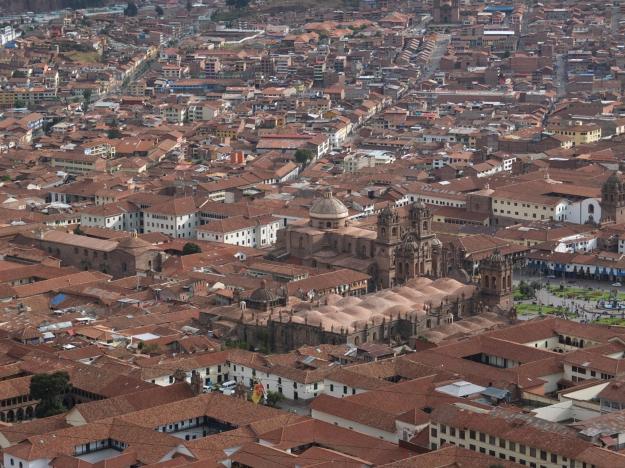
Here’s a shot from the same vantage point, zoomed in on the central cathedral; the Monasterio (our hotel) should be just up and left from center, can anyone spot it (I can’t)?
Back in town, we stopped off to see Koricancha, “Temple of the Sun”, which was an old Inca structure upon which a monastery was built, with the original structure left largely intact. Here’s a shot of some of the original stone, with a glimpse of the Spanish super-imposed structure in the background.
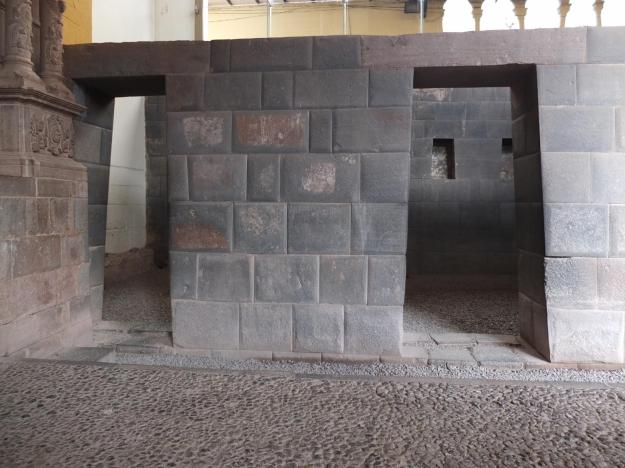
Look at the incredibly fine and precise shaping and joinery. That’s without mortar, folks. And this is a seismically active part of the world. The canted angles in the doorway and the walls (alternately angled in and angled out—you can’t tell from this picture, but the wall facing us is angled away) apparently help the seismic waves “roll” through the structure with (relatively) low stress, along with the lack of a brittle adhesion between the parts. Really amazing. You see these same construction techniques (and design…as in aesthetics!!!) repeated throughout Incan architecture.
Here is one more picture from the site, again showing the skill of the construction.
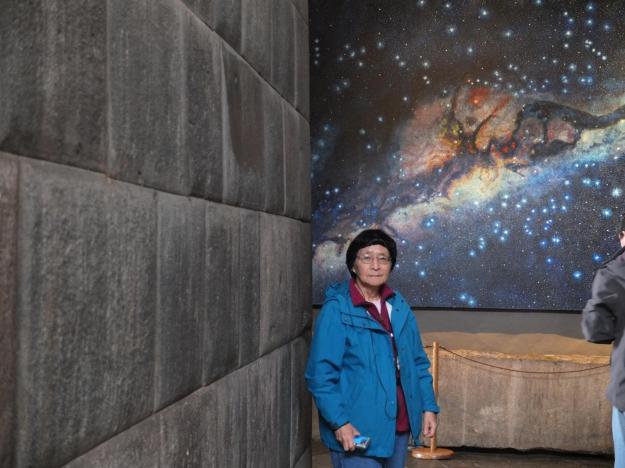
The large poster behind Mom is a modern-day artist’s rendition of how they interpreted the Milky Way. Instead of connecting stars with lines (I mean, seriously, how good a connect-the-dots picture have you ever seen, especially a 6- or 7-point figure, as in your average western constellation?), they saw figures in the dark spaces within the galactic cloud. The images discernable here include a killer ferret squashing a giant ant, while sucking the brains out of ET wearing a tutu; and a star-bellied sneetch holding an AK-47 and doing a swan dive. Do you see them too? Well, either way, the Incas thmhajaought the meaning of life and the universe were contained in those figures.
So we’re actually back from Machu Picchu by now, but I won’t have time to post anything about it until tomorrow or the day after (whichever day of the week that is, I’ve lost track by now). Well, you may be surprised to hear that I only have 4 photos of Machu Picchu itself, I’ll explain later in the post.
 semelinvita
I’m really enjoying your posts, Lei. Quite entertaining. Was particularly enthralled today by the canted angles in the Incan doorways and looking at the empty spaces between stars to create stories and meaning…what an interesting perspective! Still waiting to hear what a “chifa” is…
I hope this isn’t too anticlimactic, but “chifa” is simply a Chinese restaurant in Peru. But Mom and I were laughing about it a lot because:
Sorry to leave you hanging on this one.