One of my favorite remembrances from my travels in Central America in 1990 (during my questing, itinerant years—I’m much more domesticated now), was my journey to Tikal. Notice that I said “journey to” rather than “visit to”, but actually my visit to Tikal was also memorable—I just wish I could remember more of it (no camera, no blog—the only vestiges, a rusty brain and a notebook of letters written in an indecipherable hand, which will likely never be decoded). The strongest single memory that I have is of sneaking back into the park after dusk (after paying off a guard, is how I recollect it) with a couple of fellow travelers, and scrambling up one of the tallest temples (which I now believe is Temple IV), climbing up two or three stories though tunnels and ladders within the temple edifice, and ending up on top of the “comb” of the temple. From there we watched the end of the sunset, and the jungle below darkening and falling away into an amorphous canopy—not an artificial light to be seen in any direction. The darkness, then, arousing new life within the jungle, as the grunts and howls and hoots of monkeys and other night animals emanated from the tangle of trees, and the faintest steely blue of the sky stopped in time on the horizon, eventually fading into the starry field above. The ageless spirit shadows of the jungle enveloped us, and we sat silent and still and transfixed for hours, stationed between the teaming trees and the heavens, one with the narrative of the earth and the echo of the Mayas, before finally climbing down and sneaking back out of the park and into the campground.
Or as Ernest Hemingway would have said, “We were in the jungle to see the place. It became dark. And there were monkeys.”
Okay, enough from the Way Back Machine (I’ll say something about the amenity and wonder and thrill of the journey to Tikal, and then the tragedy, in a later post), and now on to (not “onto”) the Very Recent Past Machine…let’s dial it back to yesterday. Had a great guatemalteco breakfast, with chilaquiles and black beans and rice and queso fresco and thick fluffy Guatemala-style corn tortillas, hot off the kamal. Awesome. Then on to Tikal.
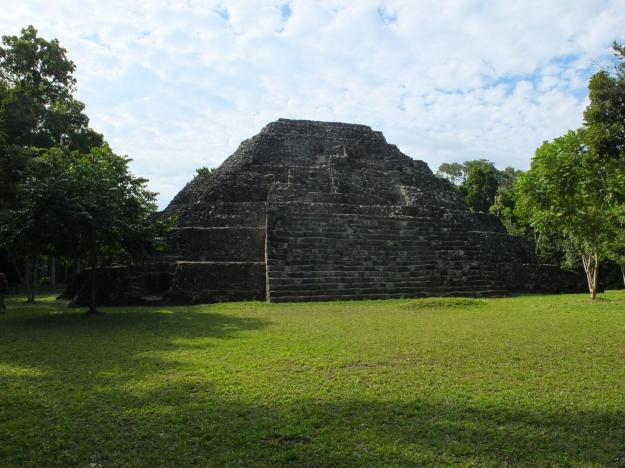
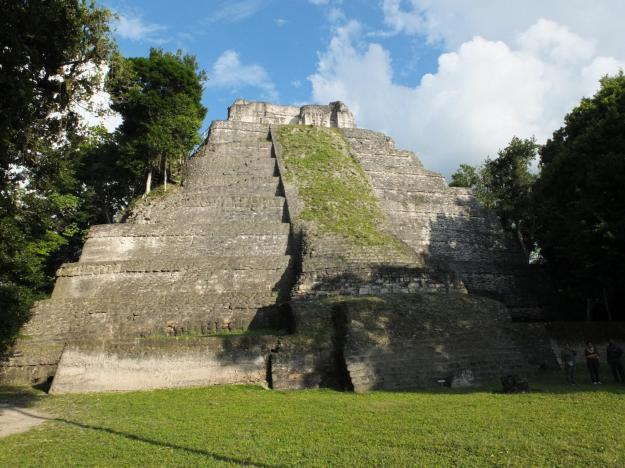
I didn’t want to dwell too much on the past versus the present—I wanted to experience the site afresh, with a new understanding of the history and the architecture and the culture, thanks to our generally excellent local guides. Our guide for the “slow group” was Jeovanni: low-key, knowledgeable, and super-accommodating. We got a special exemption to have the shuttle bus take us to the other side of the park, so we only had to do a one-way walk. We stopped on our way to Temple IV, and this is what we saw:
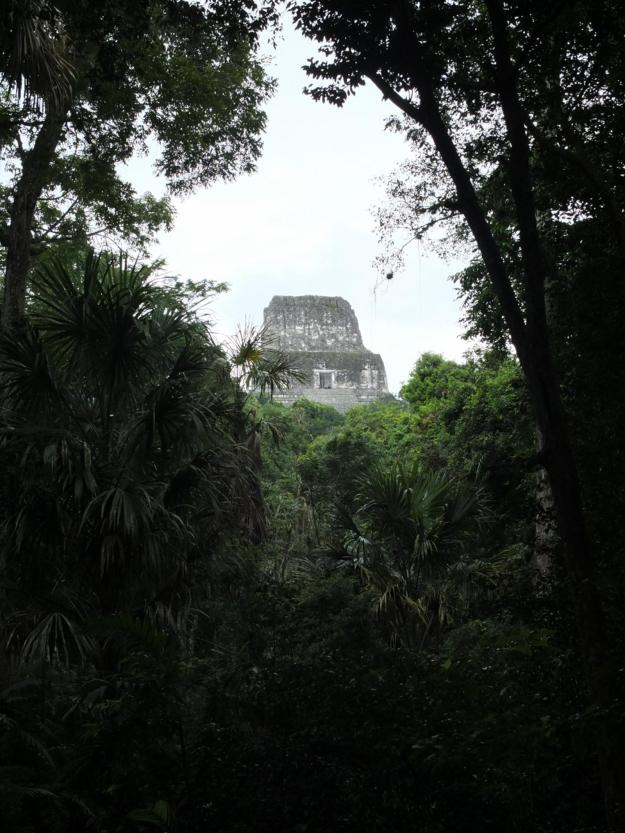
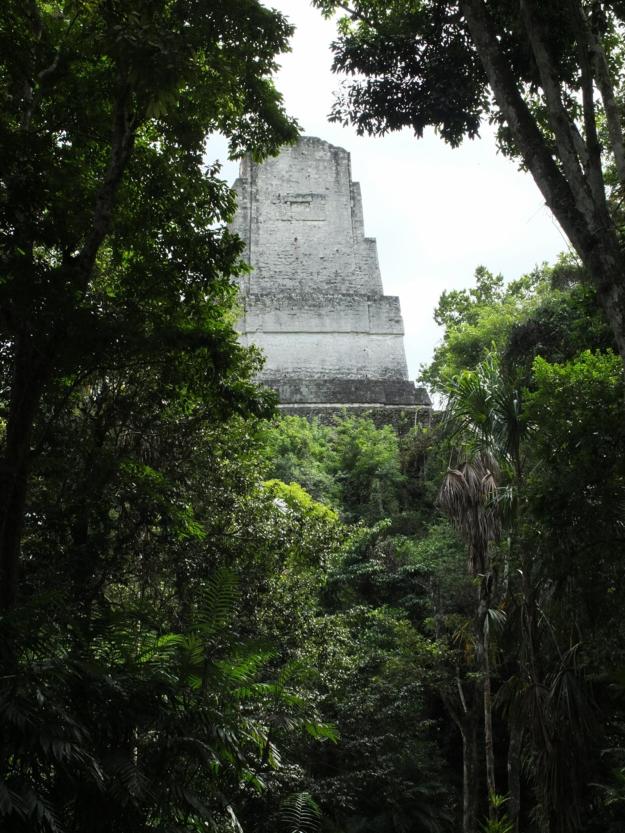
Note that the base of this shot does not even reach the ground. This is the largest temple on the site, 70 meters high, and a stunning monument rising out of the jungle. The bottom two-thirds of the pyramid [sic—it’s technically not a pyramid; they have stairs on the corners, not the sides] has not even been excavated. It was the top of this temple seen by a chiclero, who then told the governor of the region, so the story goes. Needless to say, a picture can’t do the sight justice.
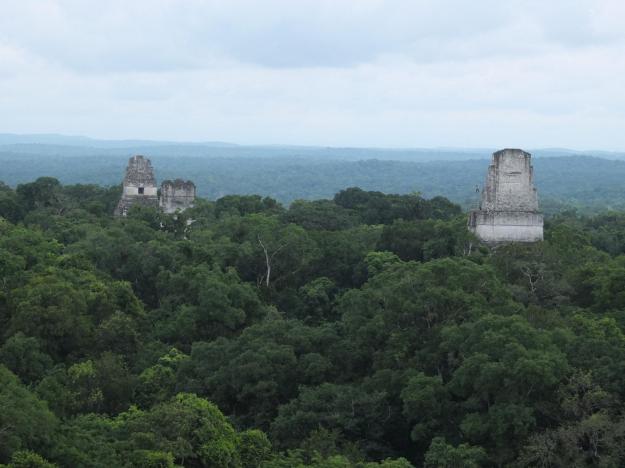
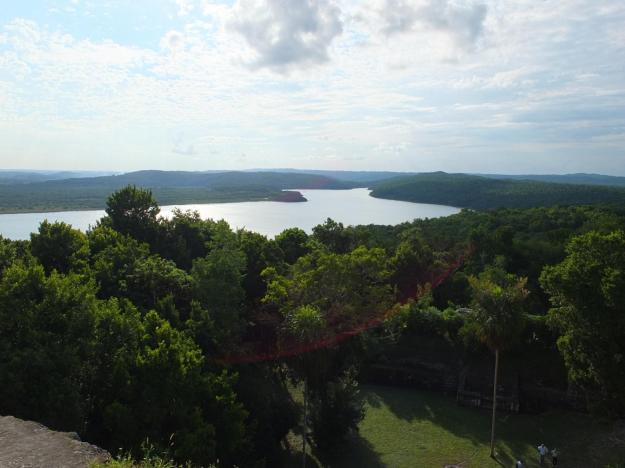
Neither can it capture the experience of the view from the top (look familiar, Star Wars fans?):

Or zooming in a little at Temples III, II, and I (respectively, nearest to farthest in the line of the Great Plaza):
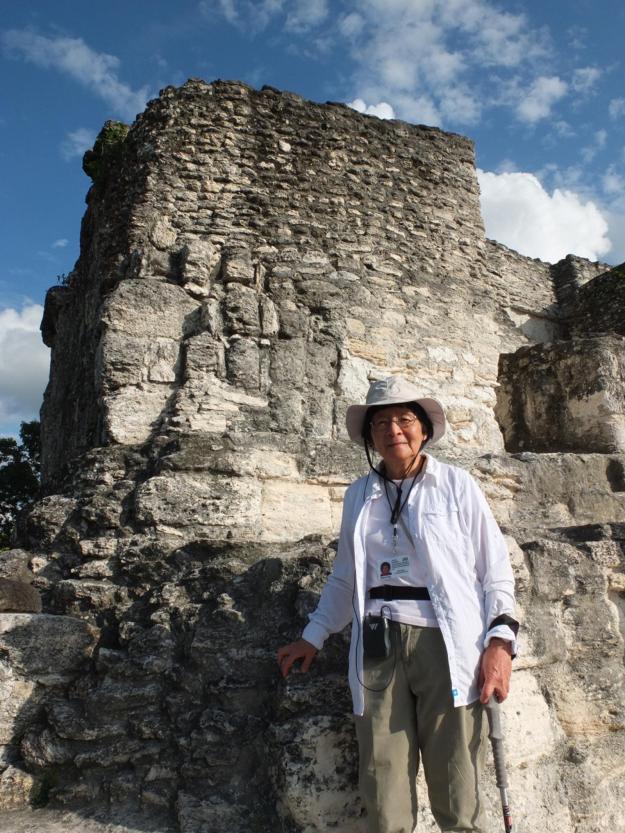
Here’s Mom (who, again made it up the zillion steps to get to somewhere worth getting to, without much difficulty), with Jeovanni up at the temple edifice (remember that first shot above, to get an idea of what kind of doozy a misstep up there would be):
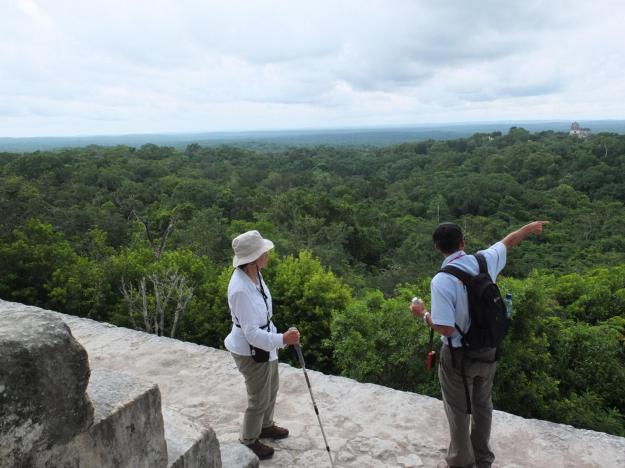
And there were others in our group, for whom (who?) the climb was a substantial physical challenge, who really gutted it out and were rewarded, and who (whom?) I profoundly applaud for their determination and unmitigated tenacity. I don’t want to get too teary-eyed here, but this trip, and this effort within the trip are incredible commitments for those who don’t get around so well anymore. Once back on the ground, after a careful descent of the stairs, we sat for a drink (de agua) with those few in the group who were not able to make the climb. Hearing of the magnificence at the top was tough on them—their sole bittersweet consolation, the pictures that Jeovanni snapped for them from the top with their cameras.
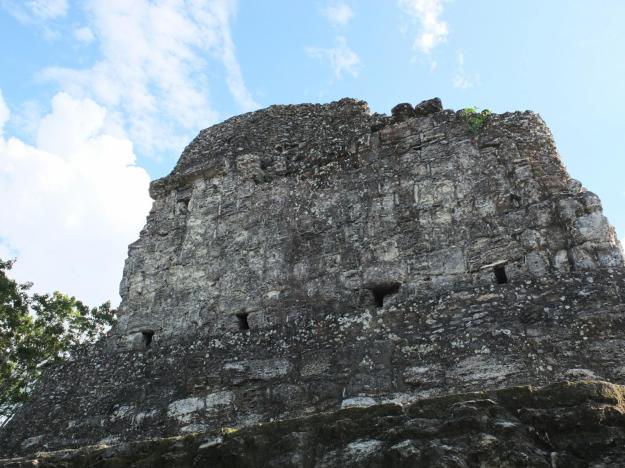
The walk back toward Temple III and the Grand Plaza behind it was a short trek through an up-and-down path cut through the jungle, which then met up with the road that we came in on. I was gratified to see those who had not climbed, take on their challenge of the jungle route, and test their own limits of perseverance. Here is the back of Temple III as we approached it:
Note that it is somewhat stupid of me to post essentially the same pictures that have been taken and published countless times by others—them with better equipment and artistic eye and shooting conditions, etc. But, obviously I’m not competing with them. These photos serve as testament not just of where we were and what we did, but rather of how we did it. By the sequence of the shots, they show us the order in which we did things, and in some cases, the pacing as well. By the composition of the shots, they show us what our eyes and minds and consciences were drawn to. And by the faces and the postures that are sometimes captured, they show us the spontaneous emotions produced by the experience.
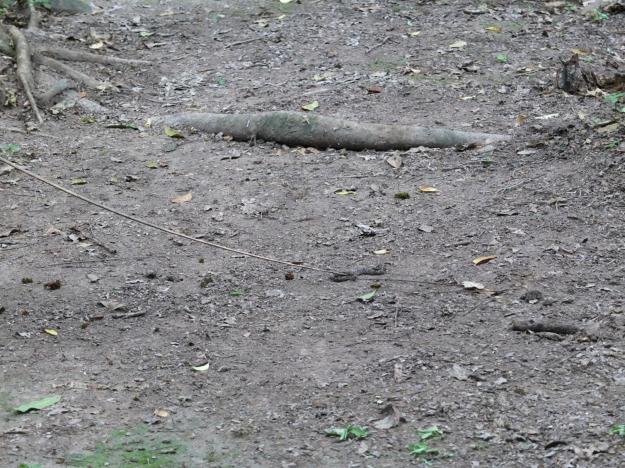
A couple of obligatory wildlife shots. Here’s a baby fer-de-lance that a park worker swept out of the underbrush as he was cleaning around a path (that’s him prodding it with the blade of a palm frond, trying to get it in a more photogenic position—either that, or trying to get it to leap at our throats):
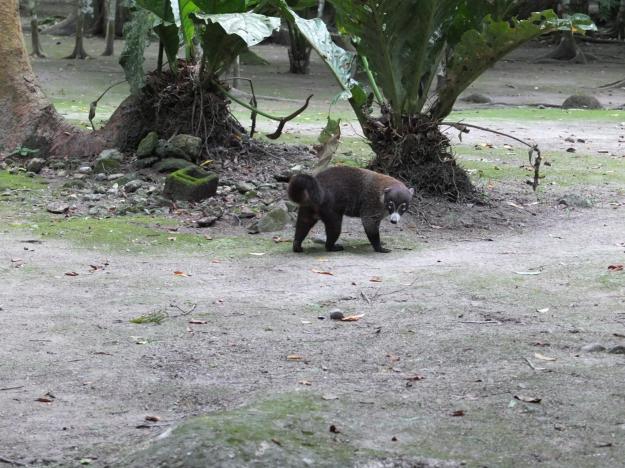
And here’s a pizote (also known as a koatymundi) hanging out near the refreshment palapa, outside of the Great Plaza, basically just a more docile, but no less objectionable, cousin of the North American raccoon (I didn’t care much for his manners, freakin’ groveler, or his looks for that matter):
Here are some shots from the Great Plaza. I’ll present them with little commentary, since it’s after my bedtime and we have to get up early tomorrow for departure to Cusco (we’re already in Lima, I’ll talk a little about that tomorrow).
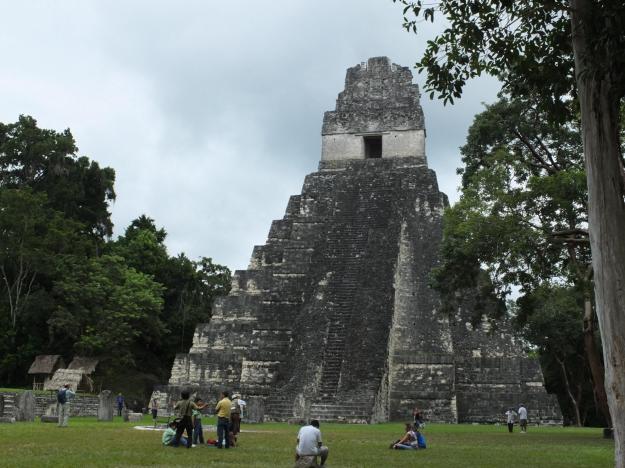
Temple I:
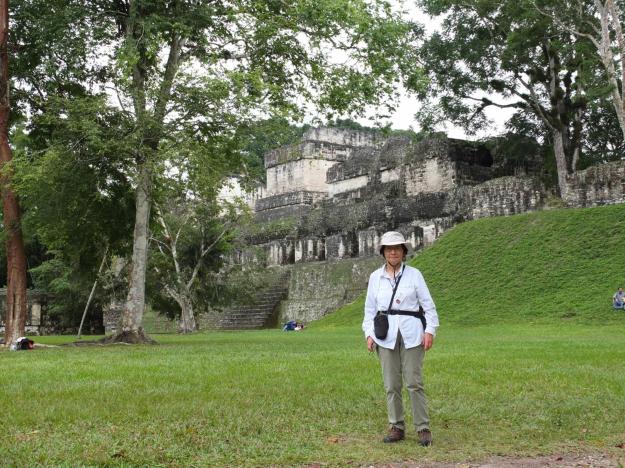
Mom in front of the Central Acropolis (off of the Great Plaza):
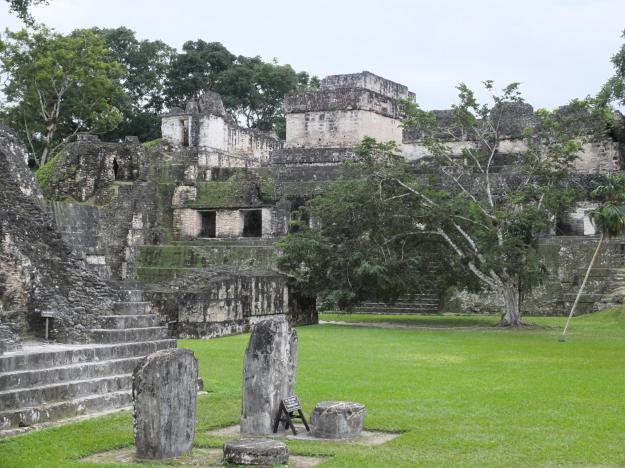
Different view of the same structure, look how awesomely architectural this is (“Architectural, duh, it’s a building, dude!” “Yeah, but this could seriously be like 13-Jaguar Lloyd Wright”):
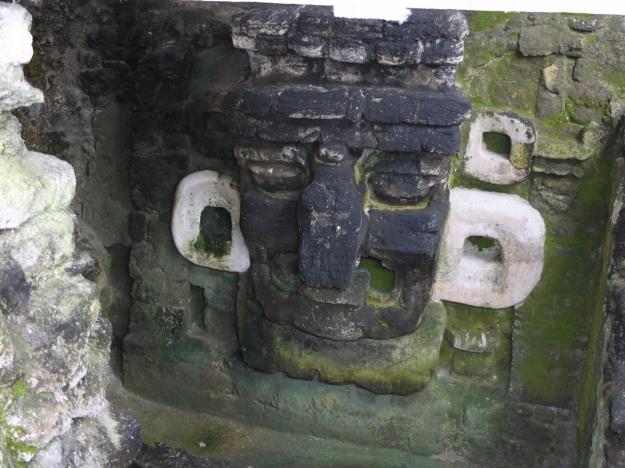
This extreme looker with the earrings is the rain god, Chaac, who was discovered in a well, completely intact, when Temple 33 on the North Acropolis collapsed during restoration (“Where’s that damned temple I asked you to restore? […] What do you mean you have something better? […] Yeah right, sure you meant to do that!”):
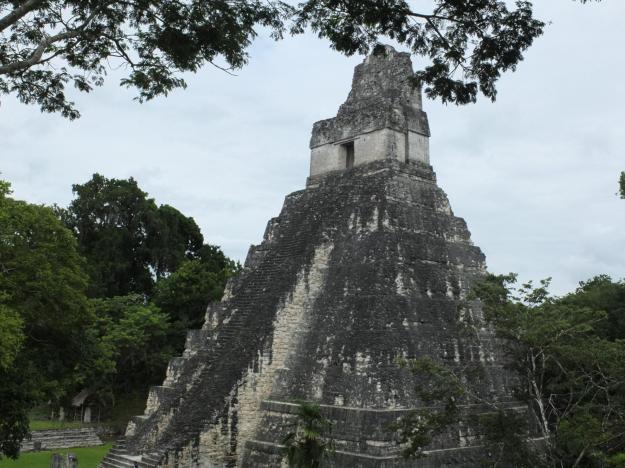
Artistic view of Temple I from the Central Acropolis, framed by beautiful tree branch (okay, maybe I am trying to compete—me with my snazzy new camera and all):
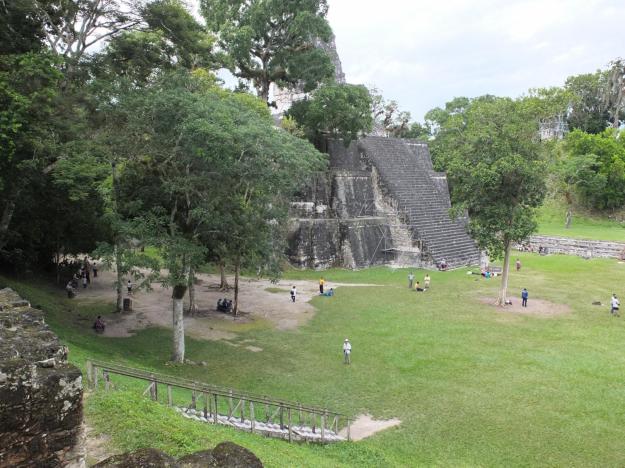
And lastly, a shot from the Central Acropolis of Mom (in the white shirt)…oh yeah, and there’s a 1300 year-old Mayan temple (Temple II) in the background.
Adios.
 semelinvita