
The next morning, while most of the tour group slept, I headed out on a morning bike and hike up to the caldera of Rano Kau, organized by one of the MIT free spirits on the trip (who has turned out to be the intrepid organizer and spiritual leader of additional independent recreational activities during the trip as well, including early morning snorkeling and pre-dawn star-gazing excursions—this was his first effort). Sorry for being so cagey on identities and not naming names for the members of the trip, but I just want to err on the side of caution in protecting folks’ privacy (though I may be going overboard on this, and completely sacrificing narrative flow in the process, but that’s the position I’m taking). Anyway, four of us, led by our local guide, Alvaro, biked it over to the foot of the volcano and hiked up a trail (apparently an old Rapa Nui ceremonial trail) to the rim. Here’s the view looking back at the town of Hangaroa (where our hotel was):
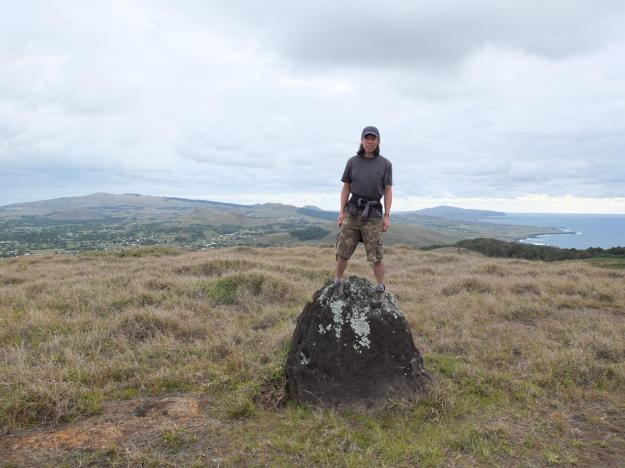
We hiked along the rim for a while, until we had to turn around to make it back in time for packing and lunch. Not super-strenuous, but a good way to take in more of the open island air and see the sights from a different vantage point. Later that afternoon, we would come back to the same volcano, but on the opposite side of the caldera (when visiting the site of Orongo Village); I’ll show pictures of the crater from that site visit.
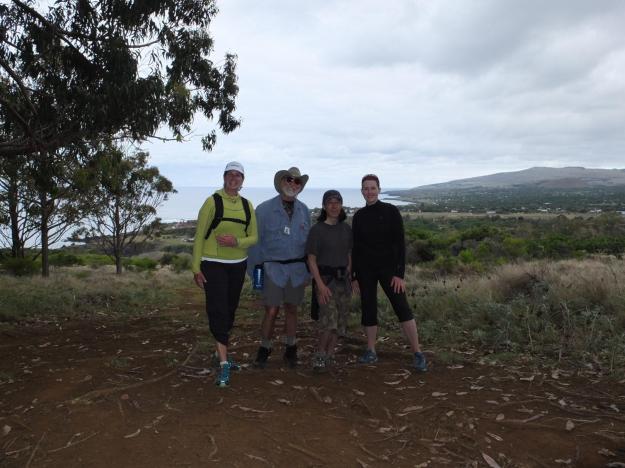
Here is the crew for this inaugural independent activity (sorry for the underexposure, I turned off the exposure bracketing to enable the fill-in flash, which somehow was also not enabled, thus completing the lose-lose on this shot, oh well…my fault, not Alvaro’s):
On our way back to the hotel, we stopped over at this site, a small rocky inlet, with a natural cave at the back of it.
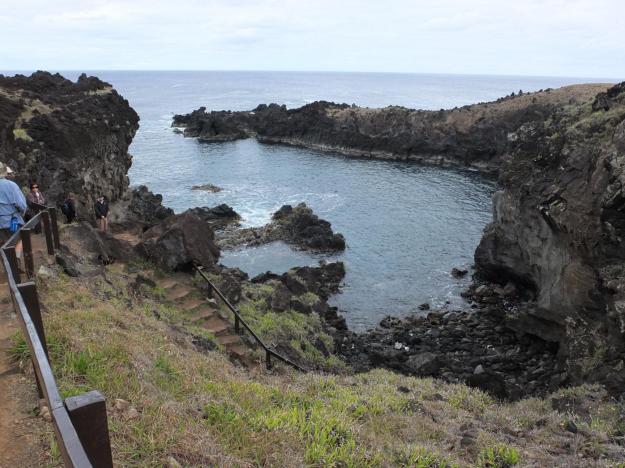
When the waves come in, they break in lively sprays of white foam over the small ring of rocks on the left-hand side of the inlet (center of the picture). We climbed down the set of stone steps and entered the cave, which is rocky and uneven and really quite shallow, and this is what we saw when we looked up at the ceiling:
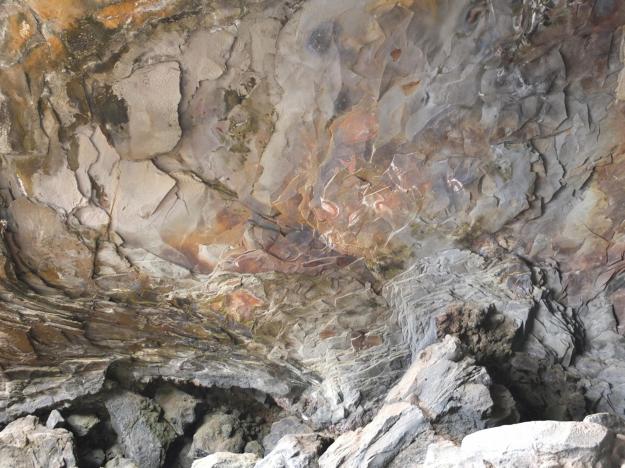
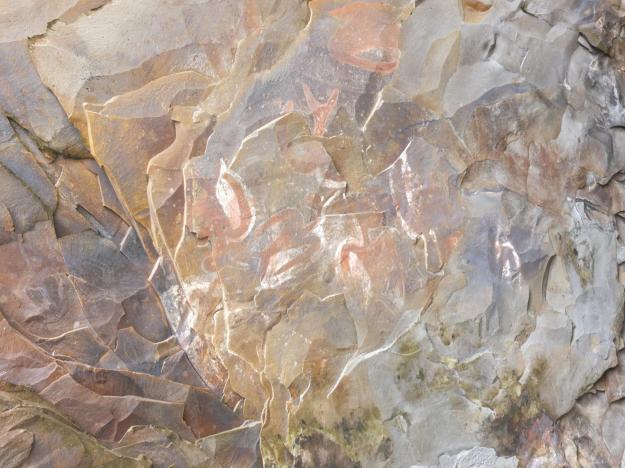
The animal figures, in red and white (and black?), were clear and quite expressive, even on the highly stratified surface, showing (I believe) the same iconography as the petroglyphs at Tongariki. It is amazing to me that the drawings are still visible, given the moisture and wind (the cave is not very well sheltered from the ocean), and occasional rushes of water that would flood the cave during storms, I would imagine. I didn’t stop to read the description posted at the site (for what it might be worth), so I don’t know if these are truly original drawings, and if so, from what era. Regardless, they somehow feel endemic to the place, despite (or perhaps accentuated by) their surprisingly good condition. Here is a closer shot for you to judge:
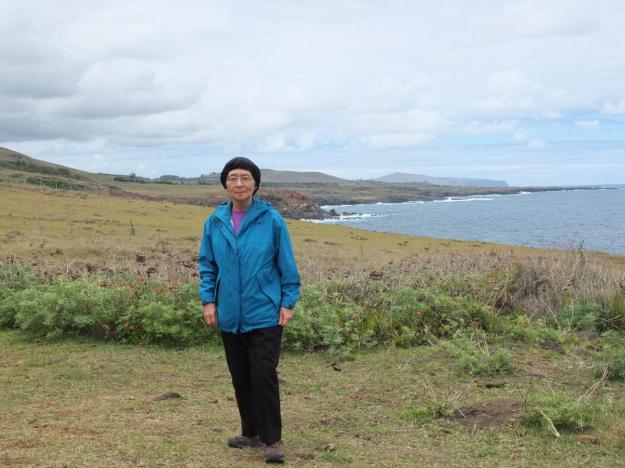
After lunch, we took a full group trip to the ancient village of Orongo, which was right next to the Rano Kau caldera, and the center of activity for the Bird Man Cult (which you can read about on wikipedia, among other places, though there is much varying information and interpretation of exactly how the politics and succession worked on the island—perhaps the true story can only be known through an old man’s dreaming). Here is Mom clowning it up a little on the edge of the spectacular caldera, close to Orongo Village (we had climbed up to the far opposite side in the morning):
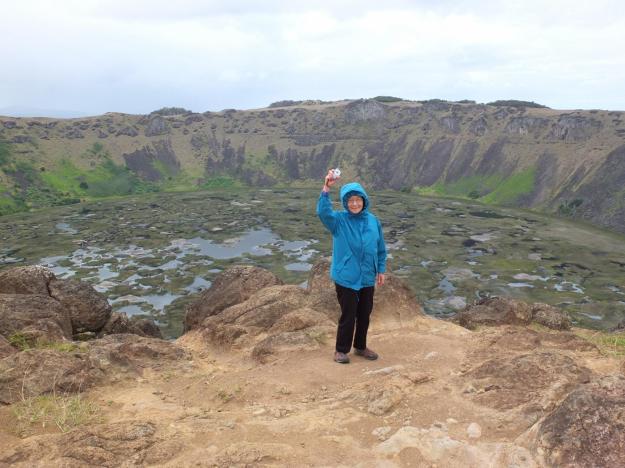
The crater appears nearly perfectly round, with an intact superscribed ring several hundred feet above the bottom of the caldera, above which are exposed rock outcroppings like castle turrets, and larger sheer rock slip planes like lookout towers. During periods of drought on the island, this was one of the few sources of fresh water; the natives carved steps down to the bottom, where they could collect the rainwater that had been trapped (not reabsorbing into the ground here).
The areas of light green growth that you can see lining the lower portion of the caldera in places, and extending down to the level of water, are actually expanses of grape vines. The story is that they were deliberately introduced by a French exploration team some time in the past, in the hopes of producing a wine crop. They have not only survived, but have flourished in the intervening years, though the grapes are apparently not currently harvested. Here is a closer view:
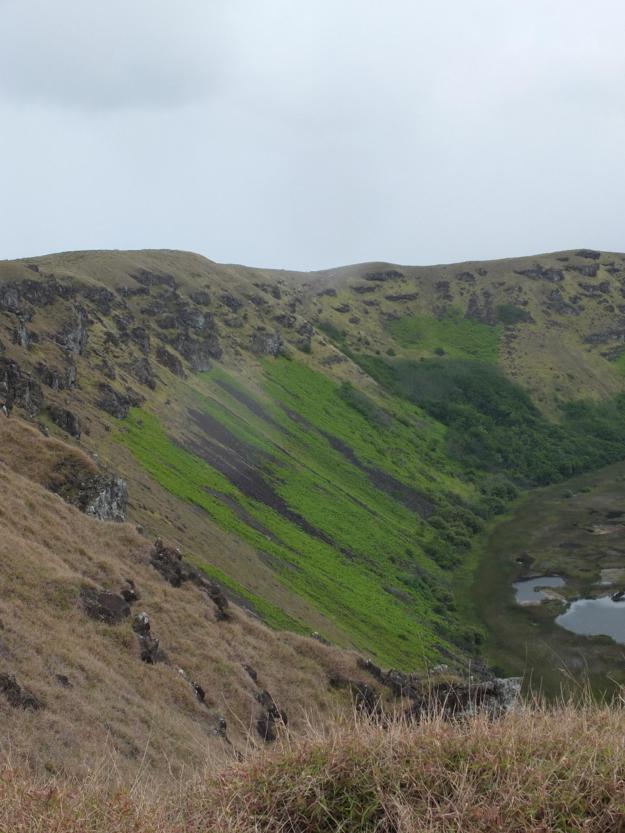
As innocuous and whimsical a story as this seems, it is emblematic of the more modern (i.e. post-1770s European exploration) history of the island. Many plant and animal species have been introduced from a variety of origins, and for a variety of purposes, and the landscape and ecology and food chain have been perturbed, bastardized, and convoluted. On the one hand, perhaps a more robust ecosystem will eventually obtain (thus, cannibalizing the ultra-fragile ecosystem that had previously existed for thousands of years); but on the other hand, perhaps the magic of this place was actually the delicate balance of elements, and ebb and flow of rich and lean times, the cyclical near-death and rejuvenation of nature that gave birth to the spirituality and dedication to fantastical human efforts, going all the way back to its initial population in the first millennium AD.
Here is a picture of the dwellings at Orongo. Apparently these were used to house the participants for several months a year during the Bird Man Cult ceremonies in the later part of the pre-European explorer days.
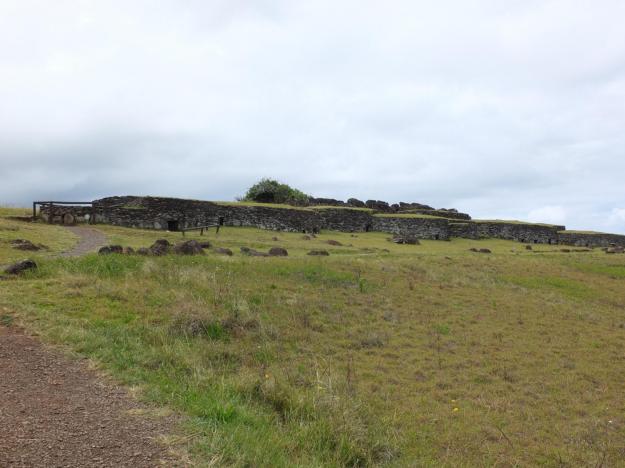
As mentioned before, these structures were clearly the model for the Hangaroa resort buildings, which have similarly rounded walls and grass-covered roofs (unfortunately, I don’t have any pictures of those). The entrances were low and the accommodations cramped (in the Bird Man Cult structures, that is, not the modern resort), and the construction of the load-bearing roofs and doorways, purely from the volcanic rock, was sophisticated, as this picture shows:
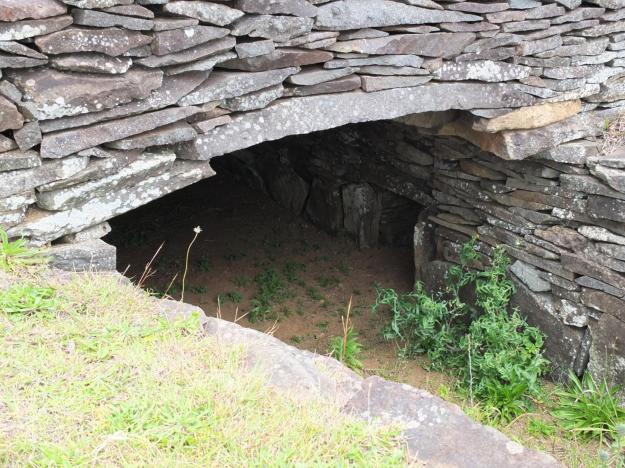
Of course, “sophisticated” does not mean perfect; Claudio showed us a structure in the complex that had collapsed and was never rebuilt, and underneath the stone from the fallen roof, was the crushed skeleton of a Bird Man Cult-era native.
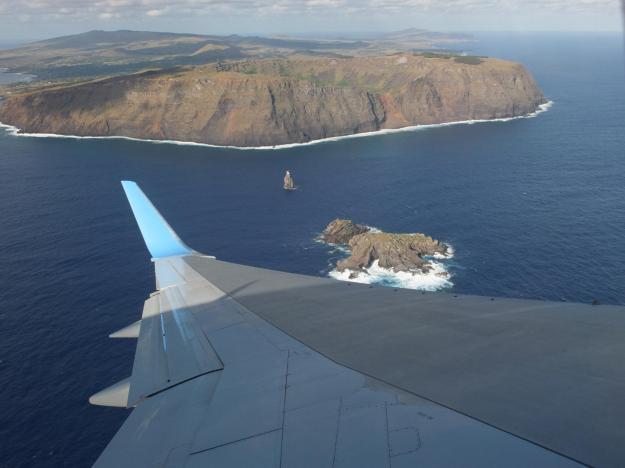
The other significant element of the Bird Man Cult ritual was the group of small rocky islets off the south-west coast of Easter Island itself, just opposite Orongo, consisting of two mostly flat (and barely occupiable) islets (a larger one and a smaller one), as well as a precipitous (not “precipitate”) rock spire thrusting up from the water, half-way between the occupiable islets and the main island.
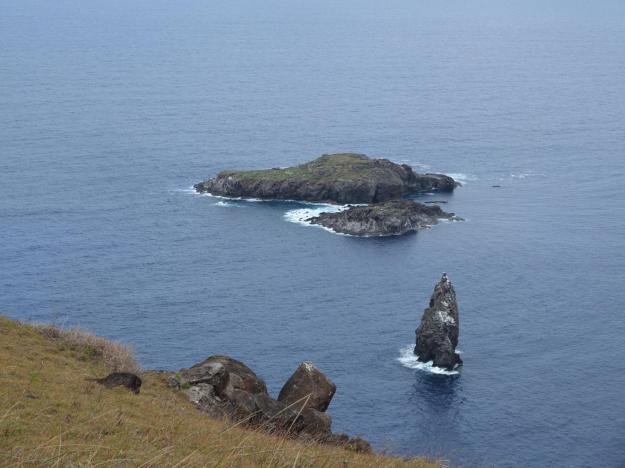
Here’s Claudio explaining to our group about the caves and dwellings and other remnants of the Rapa Nui presence and doings found on these islets:
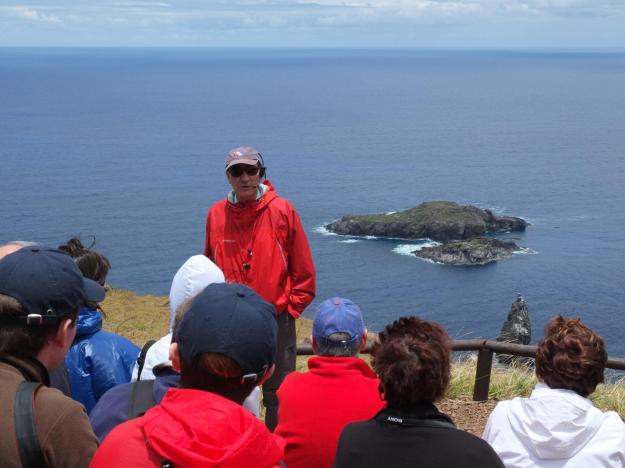
And here’s a shot from the other direction during our initial fly-around of the island, that helps put the scale of the locale in perspective:
I don’t have time or space right now to recount all that I remember from the excellent information and interpretation given us by our scientist guides, and as previously indicated, I believe it would be a disrespect, and probably a disservice, to usurp their stories, and to do it incompletely and ingenuinely [to coin a decently descriptive, if sub-elegant, word]). You’ll have to sift through conflicting and mostly speculative other descriptions of the ritual that occurred here, and try and weave them into a semi-coherent picture, at least until Claudio (or a scientist like him) is able to coalesce and publish the accumulation and refinement of decades of diligent discovery, research, and analysis, and set a new and credible baseline of understanding of the Rapa Nui people, their history, and their traditions.
The final site we visited before leaving the island was Vinapu, on the eastern shore near the end of the airport runway, and not far from Rano Kau. Take a look at the construction of this wall from the site and tell me the first word that comes to mind.
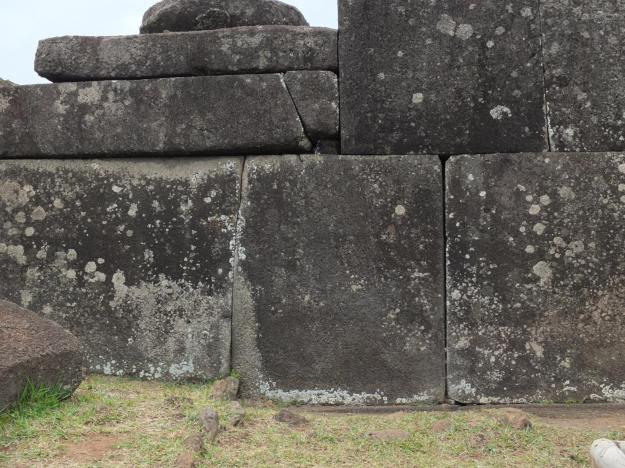
That word better have been “Inca” (if not, then either you’re not paying attention, or I need to post another dozen close-ups of rock joinery from Machu Picchu, if you can take more of it). That was also the word that occurred to Thor Heyerdahl, the ethnographer exploring the island in 1961 or so, who proclaimed that this was clear evidence that the Incas were the original settlers of Easter Island. This, of course, is easily debunked, according to Claudio Cristino and others, who cite, among other reasons for discarding this conclusion, constructional differences and ocean-navigational impossibilities (their word) in making the alleged journey from Inca territories.
To Heyerdahl’s credit, he sought to perform a comprehensive scientific analysis of the site, including a detailed investigation of the engineering techniques. To get access to the interior elements of the structure, in a moment of paradoxical, and presumably bi-polar, reconstructive/deconstructive fervor, he blasted open part of the wall with dynamite.
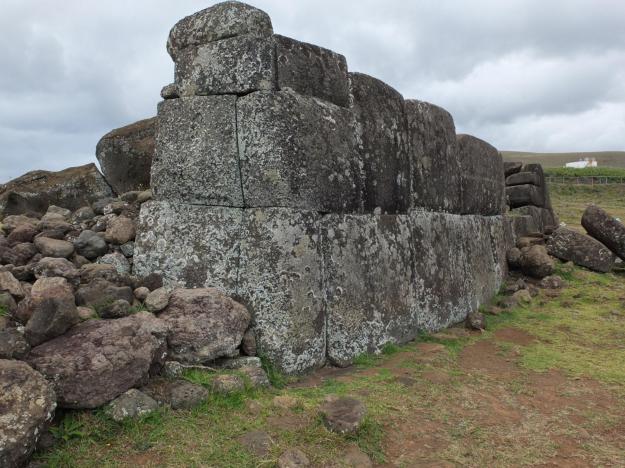
I hope he got what he wanted out of the blast, one way or the other.
Here is one final shot of the iconic volcanic terrain and gorgeous coastline of the island, just before we headed back to the airport and the plane (whose registration I know now is “Gulf Oscar Oscar Bravo Foxtrot”, or “Bravo Fox” for short, as Captain Jon and the flight crew call her).
The statues at Easter Island are indeed a phenomenon to see and to experience up close. But the wonder only begins with the viewing of, and proximity to, the Moai—it continues with the walking around and between and among them, and heightens with the unbounded imagined portrait of the old Rapa Nui people and the conditions in which they lived, and culminates with the body-permeating mana (ancestor spirit) emanating from the other-worldly legacy left us by those from a reverent and alien past.
My thanks goes out to the scientists and researchers and scholars who continue to further our understanding of this important and wondrous place, and to our guides who are able to walk us through it in such a thought-provoking and fitting manner—all of them (overlaps included) humbly serve the continuity and evolution of the human family through their effort. Our conversation with them will continue.
 semelinvita
I had forgotten about Thor Hyerdahl and remember reading KonTiki when it came out as a best seller! Beatrice, I’m so glad that you selected that lovely blue jacket for your photo ops.
The Easter Island figures are so haunting.
Pingback: Philosophy Told in Marfa | semelinvita